Trying to choose between a gated golf community and a waterfront home in Bonita Springs? You are not alone. In this part of Southwest Florida, both lifestyles are central to how people live, relax, and spend time outside, so the decision often goes far beyond square footage or price. If you are weighing convenience, costs, access, and long-term fit, this guide will help you compare the two with more clarity. Let’s dive in.
Why this choice matters in Bonita Springs
Bonita Springs gives you real access to both worlds. The city says the Imperial River runs through downtown, Bonita Beach has 10 beach accesses, and the broader Fort Myers area, including Bonita Springs, has more than 50 public and private golf courses.
That means you are often choosing between two different lifestyle systems, not just two different home styles. One may center on club amenities, internal roads, and a managed neighborhood feel. The other may revolve around boating, paddling, beach time, and water access that extends beyond the property itself.
What gated golf living feels like
A gated golf community often offers a more centralized experience. You may have shared amenities, maintained common areas, internal streets, and a clubhouse that shapes daily life.
In practical terms, that can feel more predictable and more packaged. If you like having many amenities in one place and want a neighborhood structure with organized upkeep, this setup can be appealing.
Golf communities often bundle lifestyle and costs
Florida law requires HOA budgets to separately show fees or charges paid for recreational amenities. The law also says common areas and recreational facilities must be available to parcel owners and invited guests for their intended use.
For you as a buyer, that means the monthly number is only part of the story. A golf community may include more built-in lifestyle value, but it may also come with a more layered fee structure than a standard neighborhood.
Similar communities can have very different fees
Two gated golf communities can look similar from the street and still operate very differently. Florida law allows assessments to vary among parcel classes based on factors like development stage or service levels.
Reserve funding is another key difference. It is not automatic unless the governing documents or membership provide for it, so one community may fund upkeep more proactively while another may keep fees lower now and leave more room for future special assessments.
What waterfront living feels like
Waterfront living in Bonita Springs is usually more connected to the broader natural setting. You may be thinking about the Imperial River, Estero Bay access, Bonita Beach, boating, kayaking, paddleboarding, or simply using the water regularly instead of just viewing it.
The city describes the Imperial River as a route for kayaks, canoes, and paddleboards that winds through Bonita Springs into Estero Bay on the Gulf. Lee County also notes that the Imperial River Boat Ramp has two boat ramps, a paddlecraft launch, a pier or dock, and restrooms.
Waterfront can be active, not just scenic
If you want routine access to the water, Bonita Springs offers practical entry points. Lee County says the Imperial River Boat Ramp costs $5 per day per vehicle, and the county offers a $60 annual parks parking pass that works there and at several other beach and water-access locations.
That makes waterfront living especially compelling if you plan to use a boat, kayak, or paddleboard often. For many buyers, the value is not just the view. It is the ability to step into a water-centered routine.
Waterfront can mean more independence
Unlike a golf community, waterfront living may feel less centralized. Your lifestyle may depend more on your specific property features, nearby public access, and how you personally use the river, bay, or beach.
That can be a big plus if you prefer flexibility over a club-style environment. It can also mean you need to evaluate more property-specific details before you buy.
Comparing ownership costs
The right choice often comes down to what kind of costs you are comfortable carrying. Golf communities and waterfront properties can both be expensive, but the cost categories are often different.
Here is a simple way to think about it:
| Lifestyle | Common cost focus |
|---|---|
| Gated golf | HOA fees, amenity charges, reserves, possible special assessments |
| Waterfront home | Flood insurance, dock or seawall upkeep, permitting, drainage and mitigation |
| Waterfront condo | Condo dues, reserves, structural reviews, insurance and building upkeep |
Golf buyers should read beyond the monthly HOA fee
In a golf community, ask what the fee actually covers. Florida HOA law requires annual budgets and official records, and for communities created after October 1, 1995, governing documents must describe how expenses are shared.
You will want to know whether the number you see includes recreational amenity charges, how reserves are handled, and whether different parcel classes pay different assessments. A lower fee is not always the better value if major upkeep is not being funded adequately.
Waterfront buyers should focus on carrying costs
In Lee County, property taxes are based on assessed value plus non-ad valorem assessments. Current-year taxes are billed in November and due March 31, and the county notes its estimator is only an estimate.
If the home will be your permanent residence, homestead exemption may apply if filed by March 1. Lee County also notes that homestead exemption is not generally a benefit for a seasonal second home, which matters for many Bonita Springs buyers.
Flood, drainage, and insurance matter more on the water
This is one of the biggest dividing lines between the two lifestyles. If you are buying waterfront, you need to look closely at flood zone status, elevation, and insurance implications.
FEMA and the National Flood Insurance Program say flood insurance is required in Special Flood Hazard Areas when the mortgage is government-backed. FEMA also notes that every flood zone has some level of risk, and the NFIP says an elevation certificate can affect premium pricing.
Local water management should be part of your review
Bonita Springs says it operates an extensive stormwater system and adopted the Imperial River Basin Management Plan. The city also notes historic flooding occurred in 2017 in the Imperial River watershed.
That does not mean every waterfront property is a problem. It does mean you should treat drainage, flood history, and mitigation as part of your due diligence, not as afterthoughts.
Stormwater costs are part of the picture
The city says residential stormwater assessments are charged at $20 or $50 depending on impervious surface. On their own, those numbers may not drive your decision.
Still, they reflect the broader reality of waterfront and near-water ownership in Bonita Springs. Water management is part of the local ownership landscape.
Docks, seawalls, and shoreline structures add complexity
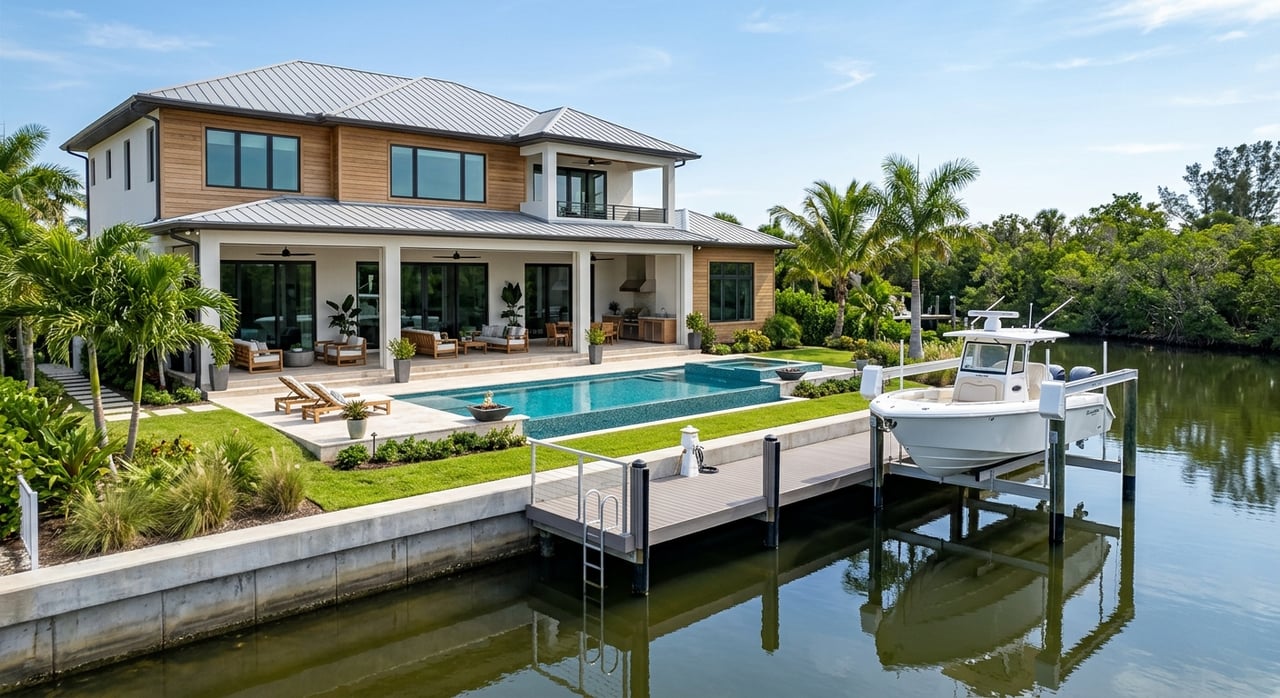
A waterfront property may come with infrastructure that is valuable but not simple. If the home has a dock, lift, seawall, or similar shoreline feature, expect more upkeep and more review than you would with an inland home.
Lee County’s Permit Center lists a Dock and Shoreline Permit for dock and shoreline structures. Florida DEP also regulates dock- and seawall-related dredge-and-fill work, which means improvements and repairs may involve permits, approvals, and timing.
Waterfront maintenance is not just cosmetic
This is where many buyers need better clarity before they commit. You should ask who maintains the dock, seawall, or lift, what condition each item is in, and whether any recent work required permits.
For some buyers, this added layer is worth it because boating access and waterfront use are the priority. For others, it becomes a reason to choose a managed golf setting or a condo with fewer individual exterior responsibilities.
Condo buyers need a separate checklist
If you are comparing a waterfront condo to a golf community home, remember that condos are governed differently. Florida condominium law requires detailed annual budgets.
Many owner-controlled condo associations in buildings three habitable stories or higher must also complete a structural integrity reserve study at least every 10 years. For existing associations subject to that rule, the deadline was December 31, 2025.
Lower maintenance does not always mean lower risk
A condo can reduce day-to-day owner maintenance, which is attractive for second-home buyers. But that does not automatically mean lower total cost or fewer financial variables.
You still need to review reserves, budgets, and the building’s overall maintenance position carefully. That is especially true in coastal markets where insurance, structural planning, and long-term upkeep can materially affect ownership costs.
Which lifestyle fits you best?
The better option depends on how you want to live in Bonita Springs. If you want a more contained amenity environment with centralized upkeep and a club-style feel, gated golf may align better with your goals.
If you picture regular time on the water, beach access, paddling routes, or boating infrastructure as part of daily life, waterfront may be the stronger fit. The key is not choosing the flashier option. It is choosing the lifestyle you will actually use.
Gated golf may fit you if you want:
- A structured community feel
- Centralized amenities
- Shared maintenance of common areas
- A more club-oriented daily routine
- Fewer property-specific water access questions
Waterfront may fit you if you want:
- Direct connection to boating or paddling
- Easy access to beach and water-launch points
- A view paired with active outdoor use
- More property-specific lifestyle flexibility
- Long-term value tied to coastal access and usability
The smartest way to compare Bonita Springs options
The best comparisons are rarely surface level. You want to compare not just the homes, but also the fee structure, reserve strength, flood exposure, insurance profile, permitting needs, and how often you will really use the amenities that come with each lifestyle.
In Bonita Springs, those details can change the ownership experience in a major way. That is why local guidance matters, especially when waterfront access, HOA structure, insurance realities, and long-term carrying costs are all in play.
If you are weighing gated golf against waterfront living in Bonita Springs, working with a team that understands coastal property details can help you make a clearer decision. Connect with the Alex King Group for insight on waterfront access, HOA questions, insurance considerations, and which lifestyle best matches how you want to live in Southwest Florida.
FAQs
What is the main difference between gated golf and waterfront living in Bonita Springs?
- Gated golf living is usually centered on shared amenities, club-style structure, and HOA-managed common areas, while waterfront living is more tied to boating, paddling, beach access, and property-specific water use.
What should you ask about HOA fees in a Bonita Springs golf community?
- Ask what the fee covers, whether recreational amenity charges are listed separately, how reserves are funded, and whether different parcel types pay different assessments.
What flood questions should you ask about a Bonita Springs waterfront home?
- Ask whether the property is in a flood zone, whether the lender will require flood insurance, whether an elevation certificate is available, and what the home’s flood history and drainage conditions show.
What extra maintenance comes with Bonita Springs waterfront property?
- Waterfront ownership may include upkeep and permitting for items like docks, lifts, seawalls, and other shoreline structures, in addition to insurance and general property maintenance.
What should you review before buying a Bonita Springs waterfront condo?
- Review the condo budget, reserve levels, maintenance plans, and whether the association is subject to structural integrity reserve study requirements.
Does homestead exemption apply to a seasonal home in Lee County?
- Lee County says homestead exemption applies to a permanent residence filed by March 1 and is not generally a benefit for a seasonal second home.